Stephen G. Fritz’s book
Frontsoldaten Fritz Italian
Soldiers at the Front. When War Has No Heroes
Letters and diaries from the front to tell the story of war not as a military epic, but as a human experience. Stephen G. Fritz’s book rejects rhetoric and absolution and challenges the reader to reflect on the relationship between suffering, responsibility, and ideology.
Frontsoldaten Fritz Italian
Every war tends to produce its own comforting narratives: heroes, innocent victims, blame always assigned elsewhere. Frontsoldaten by Stephen G. Fritz chooses a different and more unsettling path. It does not recount the Second World War as a military-historical event, but as a human experience lived by those who fought the war on the front lines—and lost it.
This is not a book about war, but about what war does to men. Frontsoldaten starts from this premise and does not retreat from it. As the author makes clear from the outset, this is not a traditional military reconstruction, but an inquiry into the “nature of man at war.” The Second World War remains in the background; at the center stands the German frontline soldier, observed without heroic filters and without comfortable absolution.
The methodological choice is explicit. Fritz adopts a bottom-up perspective, based on letters, diaries, and personal testimonies, consciously renouncing a strategic viewpoint. He wants to let an ordinary German soldier speak and to see the conflict through his eyes. What emerges is a war made of exhaustion, fear, waiting, and isolation. An experience marked by anonymity, in which the soldier “dies a solitary death, as if he had never existed.” No rhetoric of sacrifice, no epic of the trenches.
The book does not follow a classic military chronology or the course of major operations. Fritz organizes his material around thematic clusters, juxtaposing different voices and bringing out a collective dimension of the frontline experience. Letters and diaries are not used as simple illustrative testimonies, but as interpretive material, in constant dialogue with historical analysis. The result is a fragmented yet coherent narrative that presents war as an existential condition rather than a sequence of events.
In this sense, Frontsoldaten belongs to a clearly recognizable tradition of writing and reflection on war that goes beyond classical military historiography and openly engages with the literature of combatants and veterans. The reference point is not heroic storytelling, but works by authors such as Ernst Jünger, Sebastian Haffner, or Guy Sajer, in which the frontline experience is rendered as a total immersion—physical and mental—in a world governed by violence, discipline, and chance. Fritz distinguishes himself through historical rigor and the systematic use of sources, but he shares with these authors the idea that war must be understood from the inside, through the daily lives of those who endure it, not only through commanders’ decisions or the outcomes of battles.
The most uncomfortable—and most interesting—point of the book lies elsewhere. Fritz rejects the automatic equation between suffering and innocence. The Landser suffers, but is not therefore innocent. The sources clearly show that many soldiers were ideologically motivated and consciously participated in the violence of the Nazi system. “These ordinary men,” the author writes, “took part in tragic atrocities.” This is where Frontsoldaten escapes any accusation of propaganda: it does not simplify, it does not sharply separate victims from perpetrators, and it offers no moral refuge to the reader.
There is nothing identitarian about this book. Fritz’s analysis is an exercise in intellectual responsibility, showing how ordinary men can adhere to, believe in, and act within a radically inhuman system. It is a lesson that concerns not a nation, but a human condition.
Stephen G. Fritz’s book
Frontsoldaten Fritz Italian
The book shows from the inside how ideology, comradeship, and discipline make war a totalizing experience, capable of normalizing horror. There is no indulgence, but neither is there comforting distance. Fritz forces the reader to confront a difficult truth: extreme systems do not function only through a handful of fanatics, but through the daily adherence of ordinary men.
This choice also entails a risk, which the author consciously accepts. The absence of a traditional narrative framework may disorient readers seeking a linear account of the conflict. Frontsoldaten is neither an introductory nor a conciliatory book. It demands attention, a tolerance for ambiguity, and a certain resistance to the temptation of immediate judgment. Yet this is precisely what makes it a book that endures.
For this reason, Frontsoldaten remains a necessary book. It does not rehabilitate the German soldier, nor does it rewrite history. It challenges the comforting idea that evil is always elsewhere, always exceptional, always inhuman. It reminds us that understanding does not mean absolving, but assuming the burden of complexity. It offers no consolation and no absolution. It offers understanding, which is far more uncomfortable—and far more necessary.
Stephen G. Fritz’s book
The Italian edition of Frontsoldaten is published by Italia Storica Edizioni, edited by Andrea Lombardi, with translation by Vincenzo Valentini. This editorial project is part of a broader effort to recover and disseminate internationally significant historiographical works devoted to twentieth-century military and social history. In this case, the publisher makes available to Italian readers a work that has become a classic of “history from below,” preserving the author’s methodological and interpretive framework intact.
Frontsoldaten Fritz Italian
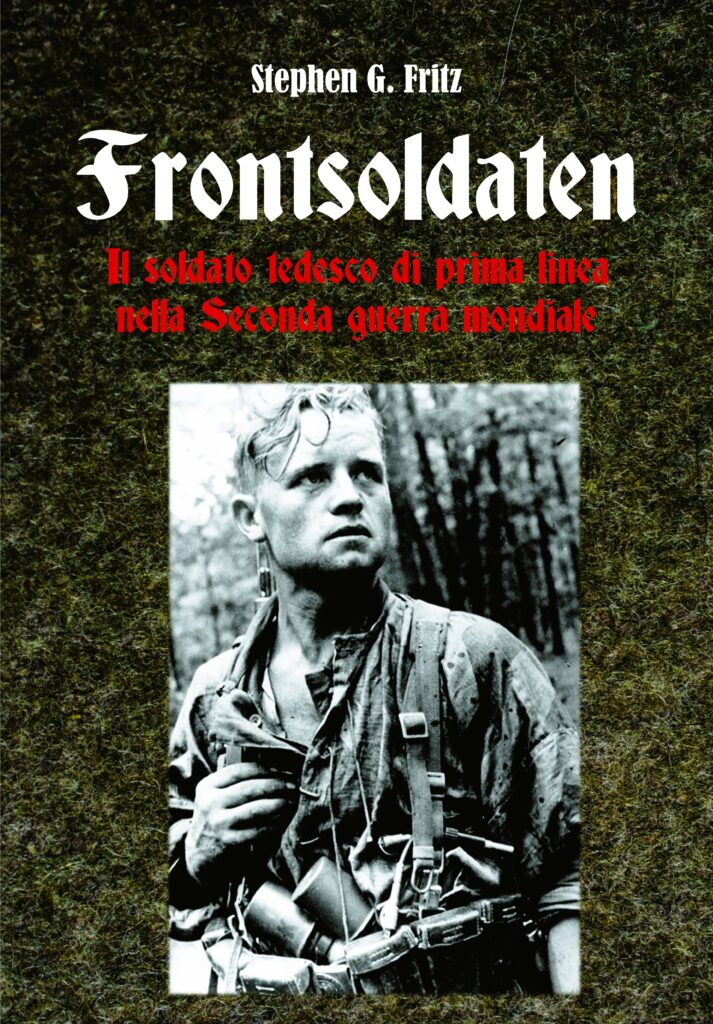
Alois Dwenger, writing from the front in May 1942, complained that people forgot “the deeds of ordinary soldiers. I believe true heroism lies in enduring this terrible daily life.” By exploring the reality of the “Landser,” the average German soldier in the Second World War, through letters, diaries, memoirs, and oral testimonies, historian Stephen G. Fritz provides the definitive account of the German frontline soldier’s experience of war. The personal accounts of these soldiers, most of whom came from the Eastern Front—where the majority of German infantrymen served—paint a richly nuanced portrait of the “Landser,” illustrating the complexity of his daily life. With chapters devoted to training, firsthand combat experience, living conditions, combat stress, personal sensations of war, bonds of comradeship and esprit de corps, ideology, and motivation, Fritz offers a sense of immediacy and depth, revealing the war through the eyes of these “ordinary men.”